

You know that feeling. You’ve been driving for an hour or two, maybe more. You finally reach your destination, step out of the car — and your neck is locked up. You turn your head and feel that familiar crunch. Welcome to the club.
Neck pain after driving is incredibly common. But here’s the thing: it’s almost always preventable. And the fix takes about five minutes and zero stretching.
Why Your Car Gives You Neck Pain
Most car headrests — sorry, “head restraints” — are designed for one thing: preventing whiplash in a rear-end collision. They are not designed for comfort or support during normal driving. Here’s what goes wrong:
- The headrest is too far back. Most headrests sit 4–6 inches behind your head when you’re in a normal driving position. That means your neck muscles have to work constantly to hold your head up.
- It’s too low. If the headrest hits the back of your neck instead of the back of your head, it pushes your head forward into a “forward head posture” — the same thing that gives people “tech neck” from staring at phones.
- You lean forward while driving. When you’re focused on the road, especially in traffic or rain, your head naturally creeps forward. Your neck muscles engage to keep it from dropping, and after 45 minutes, they’re exhausted.
Your head weighs about 10–12 pounds. For every inch it moves forward from neutral, the effective weight on your neck doubles. At 2–3 inches forward, your neck is supporting the equivalent of 30–40 pounds. No wonder it hurts.
The 5-Minute Fix: Proper Head Support
The single most effective thing you can do is fill the gap between your head and the headrest. If your headrest is too far back (which it almost certainly is), your neck muscles act as a suspension cable all day. A neck support pillow closes that gap.
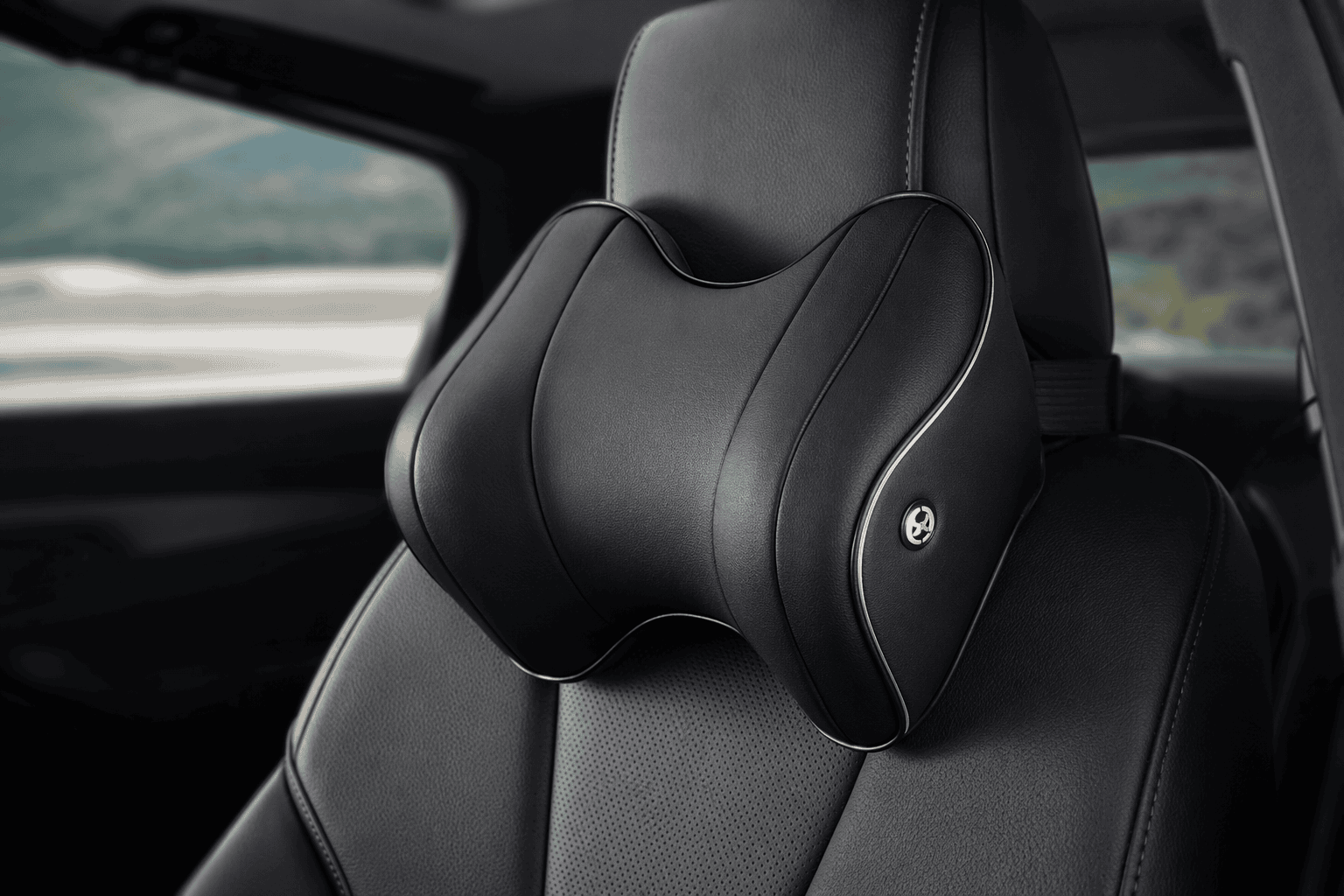
This is exactly what the IDEEAUTO neck support pillow was designed to do. It’s made of high-density memory foam that contours to the back of your head and upper neck. It clips onto the headrest posts in seconds and stays put — no sliding, no constant readjusting.
Once it’s in place, your head rests naturally against it. Your neck muscles can finally relax because the support is doing the work. The difference is immediate — you’ll feel it the first time you sit back and your head lands on something soft instead of thin air.
Bonus: Two More Things That Help
1. Adjust Your Seat Recline
Many drivers sit too upright or too reclined. The sweet spot is about 100–110 degrees — a slight recline that lets your back rest against the seat without forcing your head forward. If your seat is too upright, your head naturally tilts forward. If it’s too far back, you crane your neck to see the road.
2. Check Your Steering Wheel Height
If your steering wheel is too low, you’ll hunch forward to reach it, dragging your neck with you. Pull it out and up so your hands rest at 9 and 3 with a relaxed 90-degree bend at the elbows. This keeps your shoulders back and your neck in a neutral position.
What About Lumbar Support?
There’s a surprising connection between your lower back and your neck. When your lower back isn’t supported, your pelvis tilts backward, which causes a chain reaction: your upper back rounds, your shoulders roll forward, and your head juts out. That’s why a good lumbar support often helps neck pain too — by stabilizing the base, everything above it falls into alignment.
Most drivers benefit from using both a lumbar support and a neck support pillow together. The lumbar support keeps your pelvis neutral, and the neck pillow keeps your head from drifting forward. Together, they eliminate the two biggest posture problems drivers face.
The Bottom Line
Neck pain after driving isn’t something you have to live with. Your car’s headrest was designed for crash safety, not daily comfort. With a simple neck support pillow, you can fix the gap, relax your muscles, and arrive at your destination feeling like a human being — not a pretzel.
Start with the neck pillow. If you already have one, try adding lumbar support. Either way, your neck will thank you on your next long drive.
— Jacky